The future of the power sector
 UnsplashUnsplash
· 18 min read

The first step is to define the time horizon. The further we move from the present, the more uncertain the picture becomes. Forecasting one year ahead is relatively easy: most plans for new power plants, grid connections and infrastructure projects are already known. Forecasting five years ahead is only slightly harder, because investment cycles in the power sector are long. Today, most serious energy outlooks look to 2050, roughly 25 years ahead. Forecasts to 2060 are also becoming more common. Beyond that, we enter the territory of speculation, and that is not the purpose here.
The future is never fully knowable. Energy forecasting cannot account for every shock: wars, pandemics, earthquakes, droughts, political crises or sudden technological breakthroughs. This article therefore focuses on what can reasonably be assessed: the technological, economic and organisational development of electricity systems.
The future of electricity over the next 15–20 years is relatively transparent.
The world already has an abundance of energy sources and technologies capable of converting them into electricity. The coming decades will therefore be shaped less by a lack of options and more by competition between existing technologies, set against rapidly growing electricity demand.
No new energy source or power-generation technology is likely to appear before 2040 that would fundamentally change the global structure of the sector. Existing technologies will improve, but the main direction is already visible: electricity consumption will grow faster than overall energy consumption, while solar, wind, storage and digital flexibility tools will increasingly reshape power systems.
Fusion may finally move from laboratories toward the grid within the next two decades, but it will not reshape the power sector before 2040.
In December 2025, Trump Media & Technology Group and TAE Technologies announced a planned merger valued at more than USD 6 billion, with TAE positioning itself as a commercial fusion developer. TAE has also been evaluating sites for an initial 50 MWe fusion facility. In parallel, Commonwealth Fusion Systems has signed power-purchase agreements with major corporate buyers: Eni has agreed to purchase power from CFS's first ARC fusion plant, designed for 400 MW and planned for the early 2030s, while Helion announced a Microsoft-backed agreement targeting at least 50 MW from a first plant expected in 2028.
But even if the first projects are delivered close to their announced timelines, they will not materially affect the global power mix in the forecast horizon. Commercial fusion still needs to prove not only that it can generate electricity, but that it can do so reliably, affordably, repeatedly and at scale.
The idea of fusion as an almost infinite source of cheap electricity remains attractive, but it is not a realistic answer to today's power-sector challenges. There is no global shortage of energy resources. The real constraints are cost, speed, scalability, grids, permitting, finance and governance. Solar and wind already produce some of the cheapest electricity in history, and no fusion technology is likely to beat them on cost before 2050.
Around 730 million people worldwide still lacked access to electricity in 2024, including roughly 600 million people in sub-Saharan Africa. This is not because the world lacks suitable technologies or because Africa lacks energy resources. On the contrary, Africa has enormous solar potential. The issue is mainly institutional, financial and organisational: weak grids, underdeveloped regulation, poor investment conditions, affordability constraints and insufficient access to low-cost capital.
In practical terms, almost any type of power infrastructure can be built in Africa: solar, wind, hydro, gas, storage, mini-grids or transmission lines. The missing element is not technology, but bankable project design, stable regulation and credible mechanisms for investors to recover capital.
The same logic applies in Europe, although at a different level of development. Europe does not lack technologies for decarbonising power. Its bottlenecks are grids, permitting, market design, storage deployment, flexibility, local acceptance and the speed of investment.
Much attention is now focused on electricity demand from data centres and artificial intelligence. This is a real and important factor, but it is often exaggerated because AI is new, visible and politically salient.
According to the International Energy Agency, data centres consumed around 415 TWh of electricity in 2024, equal to about 1.5% of global electricity consumption. By 2030, this could more than double to around 945 TWh, roughly today's electricity consumption of Japan. The United States is the most exposed market: data centres may account for almost half of US electricity demand growth to 2030, and by the end of the decade the country could consume more electricity for data processing than for all energy-intensive industrial goods combined. Europe accounted for around 15% of global data-centre electricity use in 2024, making grid planning and clean power procurement increasingly relevant for European policy as well.
However, globally, data centres are expected to represent less than 10% of electricity demand growth to 2030. Industry, air conditioning, electric vehicles, heat pumps and broader electrification remain equally or more important drivers.
Electrification is an old trend. In 1973, electricity accounted for around 9% of final energy consumption worldwide. Today the share is about 20%, and in China it is already around 29%. In net-zero scenarios, electricity's share of final energy consumption rises above 50% by 2050.
In the 1960s and 1970s, electricity demand growth was driven largely by expanding access to households and industries that previously had little or no electricity. Today, the main drivers are different: electric vehicles, heat pumps, industrial electrification, green hydrogen, data centres and digital infrastructure.
This is why the 21st century is becoming an electric century.
The power sector has changed dramatically in the past decade.
A large share of new solar capacity is no longer being built only as giant utility-scale plants. Rooftop systems, commercial solar, community solar and small distributed installations now play a major role. The IEA expects distributed solar applications, residential, commercial, industrial and off-grid, to account for around 42% of global PV expansion between 2025 and 2030.
Germany is one of the clearest European examples. In 2025, the country passed the milestone of five million registered PV systems. These systems already covered almost 15% of Germany's electricity demand, with more than one million new systems installed in the previous year alone. Germany also passed two million solar battery storage systems, with stationary battery capacity exceeding 20 GWh.
Large power plants and transmission grids will remain central to electricity systems. But distributed generation will keep expanding, especially when combined with batteries, dynamic tariffs, smart meters, demand response and virtual power plants.
The most obvious trend of the present and near future is the explosive growth of energy storage.
This is driven by two forces: the rapid fall in lithium-ion battery costs and the growing need to integrate variable renewable energy sources such as solar and wind.
China is the clearest example. In 2025 alone, China commissioned 66.43 GW / 189.48 GWh of new-type energy storage capacity, excluding pumped hydro. By the end of 2025, China's cumulative new-type storage capacity had reached 144.7 GW, up 85% year on year. Total power-storage capacity, including pumped hydro, reached 213.3 GW.
The United States is also scaling quickly. The US Energy Information Administration expects developers to add a record 86 GW of new utility-scale generating capacity in 2026. Solar accounts for 51% of planned additions, battery storage for 28%, and wind for 14%. Planned utility-scale battery additions alone amount to around 24 GW in 2026, after a record 15 GW in 2025.
Storage is no longer just an auxiliary technology. It is becoming a full power-system asset: a provider of capacity, flexibility, frequency regulation, congestion relief and peak shifting.
Lithium-ion batteries will remain dominant over the next five years. After that, other technologies may gain market share: sodium-ion batteries, flow batteries, thermal storage, compressed-air storage and solid-state batteries. But even today, lithium-ion systems are moving beyond the traditional four-hour duration limit. Ten-hour lithium-ion storage projects are already being built, bringing solar-plus-storage plants closer to the operational profile of dispatchable thermal generation.

Hybrid projects, solar or wind paired with storage, are becoming standard. In high-quality resource regions, the economics are already compelling. IRENA's 2026 analysis of 24/7 renewables found that solar and wind paired with battery storage can provide firm power at costs competitive with or below new fossil-fuel generation in favourable locations.
Ten or fifteen years ago, "smart grids" were presented as a futuristic solution to many problems in the power sector. Today, the term is less fashionable, not because the idea failed, but because many smart-grid technologies have become ordinary operational tools.
Digital control systems, smart meters, forecasting models, automated dispatch, dynamic tariffs, grid sensors and remote-control systems are now part of modern electricity management.
One of the most important trends is aggregation: combining many small electricity consumers, producers and storage assets into larger controllable portfolios. These are often called virtual power plants.
Germany again shows the scale of the opportunity. A system with more than five million solar installations and more than two million batteries contains a huge distributed flexibility resource. Not all of it can be centrally controlled, of course, but even a partial aggregation could provide tens of gigawatts of flexible capacity.
Electric vehicles will deepen this trend. Vehicle-to-grid technologies, or V2G, can turn parked EVs into distributed storage assets. As EV fleets expand, the question will no longer be simply how to charge them, but how to integrate them into the power system.
Artificial intelligence will also increasingly be used to manage grids, forecast solar and wind generation, optimise storage dispatch, detect faults, and balance local energy systems. The real AI revolution in energy may not be only about data centres consuming electricity, but also about AI helping power systems operate more efficiently.
Solar and wind power can now produce electricity at historically low cost.
The global average cost of new utility-scale solar PV in 2024 was around USD 0.043/kWh, while onshore wind averaged around USD 0.034/kWh. IRENA estimates that 91% of new utility-scale renewable projects commissioned in 2024 were cheaper than fossil-fuel alternatives. Battery storage costs have also fallen sharply, making firm renewable power increasingly competitive.
The advantages of solar and wind are clear: speed, modularity, falling costs, no fuel logistics, relatively low barriers to entry and short construction times. Solar has the strongest advantage here: even large plants can be built in months. Wind power is more complex because turbines are large infrastructure assets requiring specialised construction, permitting and grid planning.
The disadvantages are also well known: variability and seasonality. But these are not fatal flaws. Power systems already manage constantly changing demand and supply. The real challenge is not variability itself, but uncertainty, flexibility and the cost of balancing.
This is why storage, grids, demand response, forecasting and market design matter so much.
Global renewable deployment is now moving at a scale no other technology can match. IEA expects renewable power capacity to increase by almost 4,600 GW between 2025 and 2030, twice the deployment of the previous five years. Solar PV alone is expected to represent nearly 80% of global renewable capacity expansion.
Ember estimates that the world added a record 814 GW of solar and wind capacity in 2025, including around 647 GW of solar and 167 GW of wind.

This is why the global electricity mix is changing quickly.
In 2025, renewables overtook coal in the global electricity mix for the first time in roughly a century. Renewables generated 10,730 TWh, or 33.8% of global electricity, compared with coal at 10,476 TWh, or 33.0%. Solar and wind growth prevented an increase in fossil generation despite continued growth in electricity demand.
Europe is already further along this path. In 2025, wind and solar generated 30.1% of EU electricity, more than all fossil sources combined at 29.0%. Renewables as a whole provided nearly half of EU electricity.
This does not mean the transition is complete. It means the centre of gravity has shifted.
A forecast to 2040 is more useful than a speculative projection to 2050 or 2060.
The trajectory to 2030 is already largely visible because many projects are planned, financed or under construction. Beyond 2030, uncertainty grows: technology costs, regulation, geopolitics, demand growth, carbon prices, supply chains and grid constraints all matter.
Still, the most likely trajectory is clear: solar and wind will grow faster than every other major source of electricity.
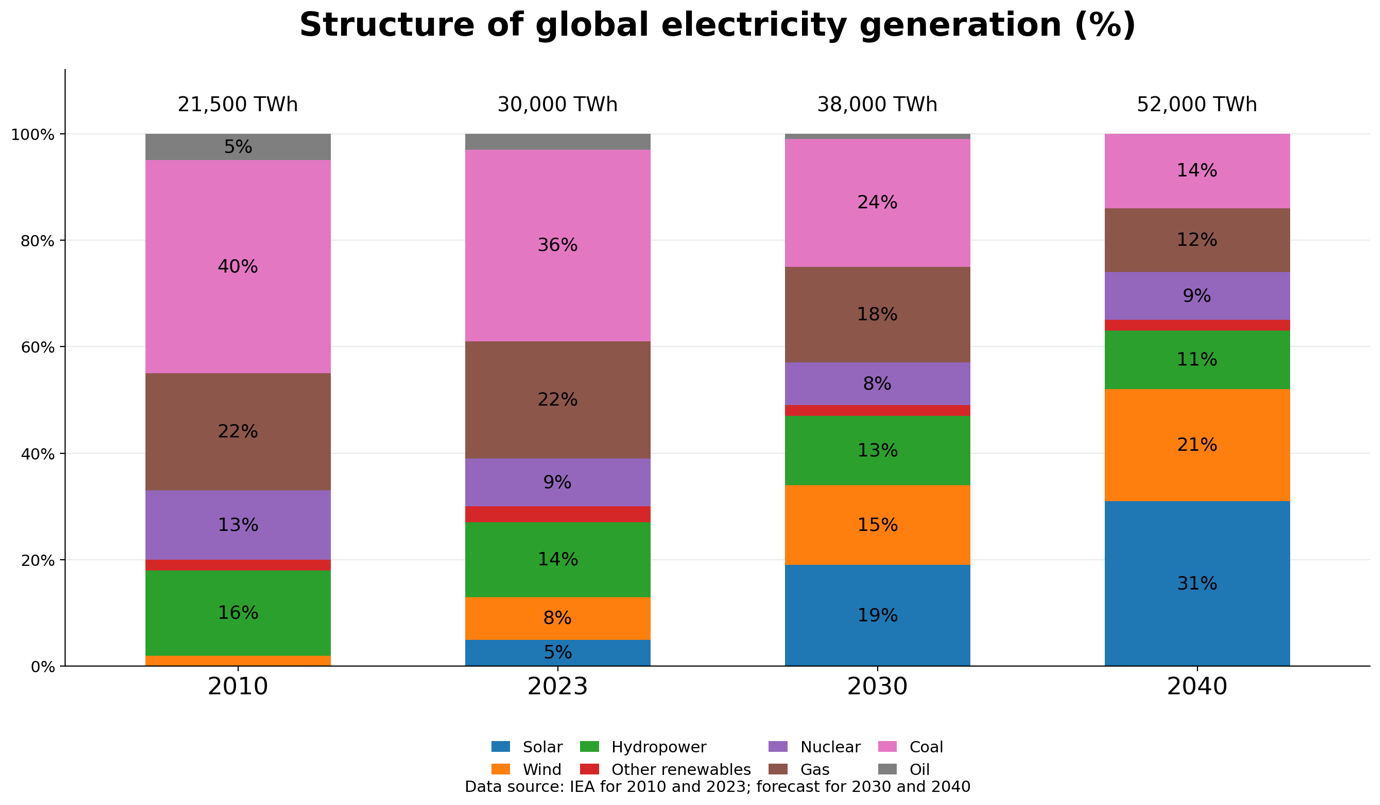
Today, these technologies already account for the overwhelming majority of annual additions to global generating capacity. There is no sign that nuclear, hydro, coal or gas can match their deployment speed.
The remaining uncertainty is not whether solar and wind will dominate new capacity. They will.
The uncertainty is about proportions: how much solar versus wind, how fast coal declines, how much gas remains for balancing, and how quickly storage and grids scale.
Nuclear power will grow, and political support for it is currently strong in many regions, including Europe, the United States, China, India and parts of the Middle East.
But nuclear generation will struggle to grow faster than global electricity demand.
The global nuclear fleet consists of about 440 commercial reactors, producing roughly 9% of the world's electricity. Many reactors are old, and new construction is slow, capital-intensive and complex. World Nuclear Association data show that nuclear remains the second-largest low-carbon power source after hydropower, but its expansion is constrained by long development timelines.
This is the key limitation. It is possible to build hundreds of gigawatts of solar capacity in a year globally. It is not possible to build 100 GW of nuclear capacity in a year, or even 50 GW, under current industrial conditions.
Small modular reactors may eventually change part of this equation. Their promise is faster, more standardised deployment. But before 2040, they are unlikely to transform the structure of global electricity generation. They may become important in specific niches: industrial sites, remote regions, district heating, desalination, data centres or replacement of coal plants. But they will not displace the main growth role of solar, wind and storage.
Hydropower will remain important, but its growth potential is limited.
In many countries, the best large hydro sites have already been developed. New large dams are expensive, slow to permit, environmentally sensitive and politically complex. Climate change also introduces new risks through droughts, changing rainfall patterns and glacier retreat.
Hydropower will continue to provide valuable low-carbon electricity and flexibility, especially where reservoirs exist. Pumped hydro will remain important for long-duration storage. But there are no strong reasons to expect hydropower to grow faster than global electricity demand.
Its share in global electricity generation is therefore likely to remain stable or decline gradually.
The future of coal power depends mainly on China and India.

China remains the world's largest coal-power producer, but its coal generation is increasingly constrained by the speed of solar, wind, nuclear, hydro and storage growth. In 2025, global renewables overtook coal, and coal's share of global electricity fell below one-third.
India is more complex. Per-capita electricity consumption remains far below China's and Europe's, while demand is still rising quickly. Coal will therefore remain important for India for some time, even as solar, wind and storage expand rapidly.
Outside China and India, there are few countries where coal generation is likely to grow enough to change the global picture. In Europe, coal is in structural decline. In the EU, coal fell to a record-low share of 9.2% in 2025, while solar alone overtook both coal and hydropower.
According to my forecast, coal's share of global electricity generation could fall from around 36% in 2023 to roughly 14% by 2040. In absolute terms, however, coal generation would decline more slowly because total electricity demand will continue to rise.
Coal decline is not only a technical or climate question. It is also a social and political issue. Coal mining and coal power employ millions of people, especially in China and India. A rapid phase-down requires regional transition policies, retraining, industrial diversification and compensation mechanisms.
The future of gas-fired generation depends on two forces: the speed of solar and wind growth, and the speed of coal decline.

Gas is often described as necessary for integrating variable renewables. There is some truth in this: flexible gas plants can provide capacity during periods of low wind and solar output. But building gas capacity does not necessarily mean high gas generation. In a renewables-heavy system, gas plants may increasingly operate as backup assets with low load factors.
In Europe, the strategic question is particularly sharp. Gas generation can provide flexibility, but imported gas also creates exposure to price volatility and geopolitical risk. The EU's recent energy crisis accelerated the shift toward renewables, efficiency, storage and electrification.
Globally, gas generation may remain more resilient than coal. It is geographically less concentrated and often easier to finance than coal in countries still expanding electricity supply. Growth is most likely in parts of Asia, the Middle East and Africa.
According to my forecast, gas could fall from around 22% of global electricity generation in 2023 to about 12% by 2040. In absolute terms, gas generation may remain close to today's level because total electricity demand will be much larger.
Gas may therefore move from being a baseload or mid-merit generation source in many countries to a flexibility and security-of-supply resource.
The power sector does not suffer from a lack of technologies. It suffers from slow investment processes.
In many countries, underinvestment in grids, outdated regulation, long permitting timelines and unclear market signals are slowing the transition. These constraints affect generation, storage, transmission and distribution networks.
Europe is a clear example. Wind and solar are now central to the electricity mix, but grid expansion has not kept pace everywhere. Solar growth is already creating periods of very low or negative prices in some countries, especially during sunny midday hours. This is not a sign that solar has failed. It is a sign that storage, demand flexibility, interconnection and market design need to catch up.
One regulatory issue is especially important: storage must be treated as a flexibility asset, not simply as both a consumer and producer of electricity. In some jurisdictions, batteries still face double network charges or outdated market rules. Removing these barriers can unlock large amounts of investment.
China shows the opposite model: strong state coordination, large-scale planning, low-cost finance and industrial policy have enabled hundreds of gigawatts of new capacity to be built quickly. But this also creates overcapacity risks and falling utilisation rates for thermal power plants.
The United States shows another version of the bottleneck. Investment appetite is strong, but grid-connection queues are enormous. In some markets, new data centres are being asked to bring new power supply with them because the grid cannot absorb demand growth quickly enough.
Europe's challenge is to combine its climate targets with faster delivery: grids, storage, clean firm capacity, flexible demand and digital system operation. The EU power system is already moving in the right direction, but infrastructure must now catch up with generation.
The future of the power sector is not mysterious.
Electricity demand will grow faster than total energy demand. Solar and wind will dominate new generation capacity. Batteries and other storage technologies will become ordinary power-system assets. Digital flexibility, virtual power plants, demand response and AI-based grid management will become standard tools.
Nuclear and hydro will remain important, but they will not grow fast enough to lead the expansion. Coal will decline structurally, though not instantly. Gas will increasingly shift toward a balancing and backup role.
The main barrier is no longer the availability of energy resources or generation technologies. The main barrier is execution: grids, regulation, permitting, investment frameworks, flexibility markets, and the ability of governments and system operators to organise the transition.
The future of electricity is therefore not just renewable.
It is electric, decentralised, flexible, digital, and increasingly European in its lessons for how complex power systems can move beyond fossil fuels.
illuminem Voices is a democratic space presenting the opinions of leading Sustainability Thought Leaders, their views do not necessarily represent those of illuminem.
The world needs sustainability knowledge. At illuminem, no interest group or shareholder can influence our work. Thank you for supporting our mission to make high-quality and independent sustainability information free for all. Every contribution helps. Thank you for donating today.

illuminem briefings

Power & Utilities · Power Grid
illuminem briefings

Electric Vehicles · Battery Tech
illuminem briefings

Power Grid · AI

Dialogue Earth

Energy Transition · Energy Management & Efficiency

BBC

Public Governance · Power & Utilities

Financial Times

LNG · Oil & Gas